
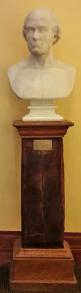
Theodore Parker (1810-1860), grandson of the Revolutionary War hero Captain John Parker, was a noted Unitarian minister, author, Transcendentalist, and abolitionist. Born in Lexington in 1810, a scholarly prodigy, he was accepted to Harvard College in 1830, but due to family financial struggles, was unable to attend. He later enrolled in Harvard Divinity School, graduating in 1836, after which he was ordained as the pastor of a Unitarian church in West Roxbury, Massachusetts. By 1840, Parker had become interested in the Transcendentalist movement, which began in New England in the 1830s, and included Ralph Waldo Emerson, Henry Thoreau, Margaret Fuller, and Bronson Alcott. Transcendentalism questioned many traditional beliefs about religion, literature, and society, while emphasizing that knowledge of divine truth was available, through intuition, to all people at all times. In 1841, Parker publicized his Transcendentalist views in a sermon on "The Transient and Permanent in Christianity." He declared that the "absolute" religion preached by Jesus was the only permanent element of Christianity, and that everything else, including belief in the miraculous authority of Jesus or the Bible, or belief in biblical miracles as more than myths, was transient, and not essential. His views, explained at greater length in his book A Discourse of Matters Pertaining to Religion, were highly controversial. These views, combined with his strong support for social reforms, led many mainstream Unitarian leaders to regard him as a dangerous radical, although he also won many admirers. His supporters eventually founded a new congregation for him in Boston, the Twenty-Eighth Congregational Society. He became its minister in 1846, and by the 1850s, his sermons were drawing nearly 4,000 listeners a week. Parker also became one of the leaders of the anti-slavery movement, an important advocate for women’s suffrage, a best-selling author, and a popular lyceum speaker. He died of tuberculosis at the untimely age of 49, on the eve of the Civil War. Parker's ideal of democracy as "a government of all the people, by all the people, and for all the people," and his concept that "the arc of the moral universe is long, but it bends towards justice," later inspired the words of Abraham Lincoln and Martin Luther King, Jr.
Sidney H. Morse (1833-1903) was a writer, sculptor and poet. Born in Rochester, New York, he initially trained as a marble sculptor in Connecticut before becoming a Unitarian minister. In his varied career, he founded and edited The Radical, a Unitarian periodical that supported free thought and religion, and was also a prolific author and speaker. Morse believed in the idea of individual sovereignty and supported the economic theory of mutualism, a school of thought that advocated for the individual’s right to receive appropriate compensation for their labor. In addition to his literary activities, Morse also worked sporadically as a sculptor and made busts of various American Rationalists and reformers of the 19th century, including such notable figures as Thomas Paine, Ralph Waldo Emerson, Walt Whitman, and Susan B. Anthony. The wood for the pedestal of this bust came from the original belfry that called the Lexington Minutemen to arms in 1775.