Press enter or spacebar to select a desired language.
Lexington, MA
Press enter or spacebar to select a desired language.

Art Collection

Selections from our Art Collection
Cary Library is proud to house and display a permanent collection of art – portraits, landscapes, plaques and objects – associated with the Town of Lexington and the library itself.
 
Works of art are on display throughout the library, with the majority of portraits and historical items located in the four historic rooms just inside the Massachusetts Avenue entrance, on the main floor.
 
Below is a list of art in each room with an image followed by a description.
6 results found

Bust of Theodore Parker (1810-1860) by Sidney H. Morse; marble, 25”x16” with 42”x14” pedestal
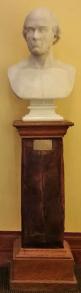
art

Theodore Parker, the grandson of Revolutionary War hero Captain John Parker, was a noted Unitarian minister, author, abolitionist, and advocate for transcendentalism. Born in Lexington, he excelled at academics and was accepted to Harvard College in 1830, but due to family financial struggles, Parker was unable to attend. He later enrolled in Harvard Divinity School, and graduated in 1836, after which he was ordained as the pastor for a Unitarian church in West Roxbury, Massachusetts. By 1840, Parker had become interested in and influenced by the Transcendentalist movement. Defying easy categorization, Transcendentalism was a social, philosophical and literary movement that began in New England in the 1830s; led by Ralph Waldo Emerson, it emphasized the essential goodness of men and the importance of intuition, imagination and individual thought over logic in the quest for the divine. Parker took elements of these beliefs to create his own theological ideas, which differed from traditional Christian teachings by focusing on a personal relationship with God based on man’s own experiences. In 1841, he publicized these views in a sermon entitled “The Transient and Permanent in Christianity,” in which he posited that the permanent was the individual relationship with God, while the transient was priestly ritual. He later published A Discourse of Matters Pertaining to Literature, which further elaborated on his beliefs and alienated many local ministers. His controversial religious views, combined with his liberal leanings on issues of social reform, which included speaking out in favor of temperance, women’s education and the abolition of slavery, meant that he was forced to resign his pastorate in 1843. He left Boston and traveled around Europe for a year; upon his return, a small but loyal group of supporters founded the Twenty-Eighth Congregational Society of Boston and made him its minister. Parker continued to preach and speak out on social justice issues until his untimely death at the age of 50. The wood for the pedestal of this bust came from the original belfry which called the Lexington Minutemen to arms in 1775.

Sidney H. Morse (1833-1903) was a writer, sculptor and poet. Born in Rochester, New York, he initially trained as a sculptor in Connecticut before becoming a Unitarian minister. In his varied career, he founded and edited The Radical, a Unitarian periodical that supported free thought and religion, and was also a prolific author and speaker. Morse believed in the idea of individual sovereignty and supported the economic theory of mutualism, a school of thought that advocated for the individual’s right to receive appropriate compensation for their labor. In addition to his literary activities, Morse also worked sporadically as a sculptor and made busts of various American Rationalists and reformers of the 19th century, including such notable figures as Thomas Paine, Ralph Waldo Emerson, Walt Whitman and Susan B. Anthony.
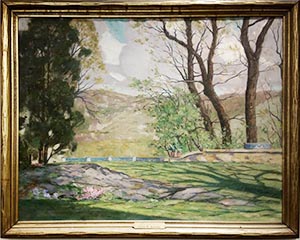
Hills of Lexington by John Enser; oil on canvas

Hills of Lexington

This painting is a typical example of Enser’s work, as it uses a vibrant color palette and a naturalistic painting style to portray a landscape scene. The particular vantage point depicted is unidentified, but is most likely the back garden of 12 Summit Road atop Follen Hill, looking northeast across the valley of Massachusetts Avenue and the Arlington Great Meadows to Whipple Hill in the distance.

John Enser lived for more than a decade in the 1930s and early 1940s in the Summit Road home of his friends and fellow artists Hermann Dudley Murphy and Nelly Littlehale Murphy. Enser and the Murphys maintained their studios in the spacious home. The contrast between the manicured lawn in the foreground and the rolling hills in the background can be seen as a nod to Lexington’s past as a rural, agricultural community as well as its present position as a prosperous suburb of Boston. 

This painting was donated to Cary Memorial Library by Paul Kossey.

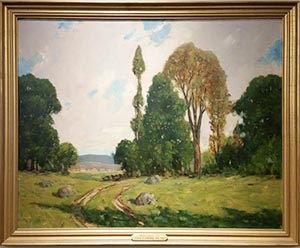
Pasture Road by John F. Enser; oil on canvas

pasture road

This painting, with its depiction of a rutted two-lane track winding through an open field, clearly evokes Lexington’s agricultural roots. First settled in 1642 as a part of Cambridge, Lexington was originally known as Cambridge Farms, a name which reflects the largely agricultural and farming-based economy of the time. Incorporated in 1713, many residents farmed and owned livestock, which were such an important part of life that a town meeting vote allowed hogs to roam freely as long as they were marked by their owners. Although Lexington had long since become a flourishing Boston suburb by the time Enser settled in town, the emphasis on the natural world and the absence of urban development in this painting seems to hearken back to a more ‘unspoiled’ time in Lexington’s history.   

John Enser (1898-1968) was born in Ennis, Texas and moved to Chicago to study painting at the Academy of Fine Arts and the Art Institute. He arrived in Boston in 1929 and struck up a close friendship with local artist Hermann Dudley Murphy (1867-1945). Enser settled in Lexington and worked in Murphy’s home studio, where he met Deirdre Cotter, who would later become his wife. Although he made New England his home, Enser frequently traveled back to Texas, as well as to Mexico. He is best known for his landscapes, particularly of New Hampshire’s Monadnock region, which are characterized by a vivid color palette. He also taught painting at the Middlesex School in Concord, Massachusetts and was on the faculty of the School of Practical Arts and Letters at Boston University. 

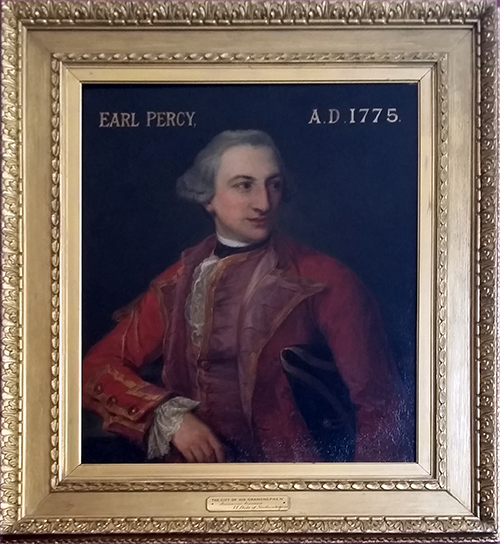
Portrait of Earl (Hugh) Percy, Lord Warkworth, later 2nd Duke of Northumberland (1742-1817) by Pompeo Batoni, c. 1775; oil on canvas, 36”x41½”

General Percy portrait

Born in London and educated at Eton College, Percy was set on a military career from an early age, becoming a gazetted ensign in the 24th Regiment of Foot by the time he was seventeen. He fought in the Seven Year’s War (1756-63) and rose to the rank of major-general during the Revolutionary War. He was in command of the British brigade dispatched by General Gage to reinforce the troops under attack by the Colonial militia on April 19, 1775, and led the British retreat into Charlestown under heavy fire. After returning to England in 1777, Percy served as a Member of Parliament and acceded to the title in 1786; by the time of his death in 1817, he was one of England’s richest men. This portrait is a copy of the original done by Pompeo Batoni, although it is unclear exactly when or where Batoni painted Percy.  The use of Percy’s title before he succeeded to the dukedom, Lord Warkworth, combined with evidence of existing copies of the work suggest that the original was made before the 1760s.  The portrait was a gift from Earl Percy’s grand-nephew, Algernon George, 6th Duke of Northumberland, in 1879 to the town of Lexington.

Pompeo Batoni (1708-1787) was born in Lucca, and likely trained there before moving to Rome in the late 1720s. Although he began his career painting altarpieces, Batoni soon established himself as one of the most popular portrait painters of the time, particularly catering to aristocratic Englishmen on the Grand Tour with skillful draftsmanship and a polished style influenced by the work of Raphael and classical antiquity. He often depicted his sitters in archaeological sites or with pieces of ruined sculpture, and was famous for truly capturing the spirit and likeness of his subjects. 

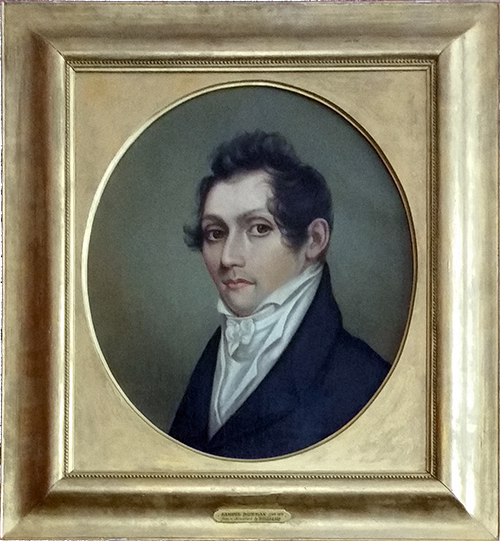
Portrait of Samuel Bowman (1753-1818) by Henry Williams; oil on canvas, 28”x32”

Gen Bowman

Samuel Bowman, a Lexington native, was one of seven brothers who served as soldiers in the Continental Army during the American Revolution. He was a drummer in Captain John Parker’s company and fought in the Battle of Bunker Hill. After the end of the war, he initially returned to his home in Lexington, but in 1786 he moved to the Wyoming Valley in Pennsylvania, where he settled on a large farm. Bowman would go on to become a valuable member of the community, serving on the borough council and taking part in the suppression of the Whiskey Rebellion in 1794. This painting was created from a miniature by Henry Williams.

Henry Williams (1787-1830) was an engraver, painter, miniaturist and wax modeler. In 1806, when he was only 19, Williams entered a partnership with William M.S. Doyle in Boston in order to meet the growing demand for his work. Their collaboration lasted until around 1814, when he published Elements of Drawing, a very popular and successful instruction manual which included an essay on the titular subject and twenty-six engraved copper-plate images.

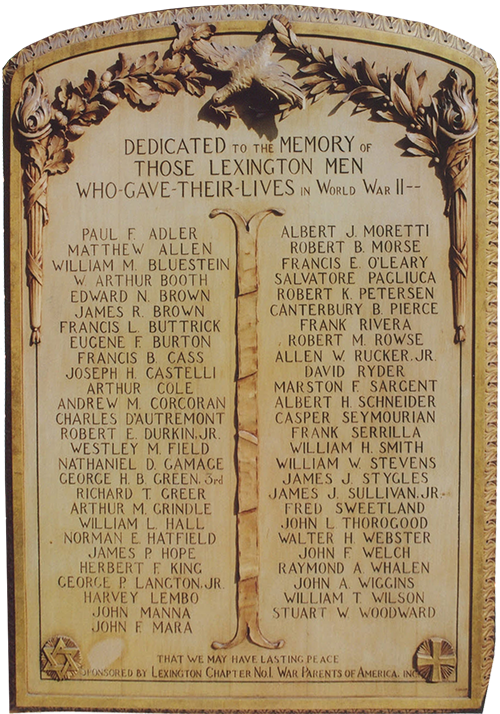
World War II Memorial Plaque

wood plaque

A carved wooden plaque is dedicated to the memory of those Lexington men who gave their lives in World War II. It is decorated with a dove bearing an olive branch – a symbol of peace – flanked by two burning torches, as well as the Star of David and a cross. Those memorialized served in all branches of the military and include recipients of the Purple Heart, as well as other medals for distinguished service. The plaque was given to the library by the Lexington chapter of the War Parents of America.